
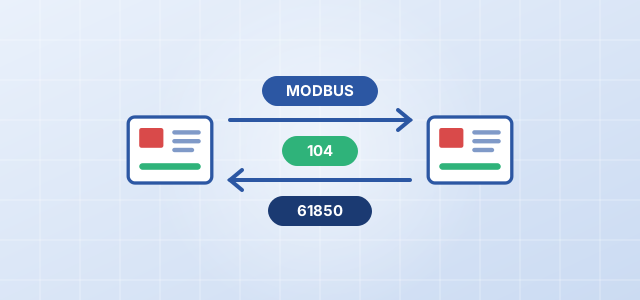
A communication protocol is the "language" devices use to exchange data. On one side, a box transformer monitoring unit connects to downstream devices such as inverters and combiner boxes; on the other, it sends data to the plant monitoring system and the grid dispatch center. The two sides often use different protocols, so the unit must support several protocols and convert between them.
1. Four Common Protocols Compared
| Protocol | Transport | Characteristics | Typical use in box transformers |
|---|---|---|---|
| MODBUS-RTU | Serial (RS485) | Master-slave polling with a simple structure, supported by almost every device; data is addressed by register, so a point list is needed to define its meaning | Connecting downstream devices such as inverters, smart combiner boxes, meters and weather stations |
| IEC 60870-5-103 | Mainly serial | Companion standard for the informative interface of protection equipment, oriented to protection events, settings and similar data | Communicating with protection devices or monitoring systems that require IEC 103 |
| IEC 60870-5-104 | Ethernet (TCP/IP) | Telecontrol protocol supporting telemetry, tele-signalling, remote control and event reporting; the most widely used protocol in China's power system | Sending data from monitoring units to the plant monitoring system and telecontrol gateway |
| IEC 61850 | Ethernet | Communication standard for substation automation; data is described by semantic models, giving good interoperability between devices | Smart substations and new plant monitoring systems that require IEC 61850 |
2. The Point List: The Most Important Document Beyond the Protocol
Modbus and IEC 104 define only how data is transmitted, not what is transmitted. Whether a given register address or information object address represents the open position of a low-voltage circuit breaker or phase-A current must be agreed in a point list. Most "data mismatch" problems during commissioning come from mismatched point list versions, address offsets (starting from 0 or from 1), or different interpretations of data format (integer vs. floating point, byte order, scaling factor).
IEC 61850 uses model files (such as ICD/CID) to describe what data a device provides. The monitoring system simply imports the model to recognize the data, greatly reducing manual point-list mapping. This is why more and more new plants specify IEC 61850.
3. Common Commissioning Issues
- No RS485 communication: Check whether the A/B wires are swapped, whether baud rate and parity match, whether any device addresses are duplicated, and whether the end of the bus needs a termination resistor.
- IEC 104 will not connect: Check the IP address, subnet, port number (usually 2404) and firewall settings, and confirm that the common address (ASDU address) matches the monitoring system.
- Values jump or are off by a factor: Verify the scaling factor, units and data type in the point list.
- Remote control commands not executed: Confirm whether the monitoring system issues select-before-operate or direct-execute commands, and check the unit's remote/local switch status.
4. Protocols Supported by the AOYI NSA Series
The NSA3, NSA2 and NSA6000 all support MODBUS-RTU, IEC 60870-5-103/104 and IEC 61850. The RS485 master ports on the NSA3 and NSA2 can convert between MODBUS-RTU and IEC 60870-5-103/104, forwarding data from all downstream devices in a unified format.
The Modbus communication protocol (register address map) for each product is available on the Downloads page. For IEC 104 or IEC 61850 point lists and model files, please call +86 10 8646 1328.